Beach Naupaka
Beach naupaka
Scaevola taccada
Beach naupaka is a large bushy shrub native to southeastern Asia, eastern Africa, Australia and the Pacific Islands, including Hawaii. The salt-tolerant beach naupaka has been available from nurseries since the 1960s. It was promoted in the 1970s and 1980s for use in beach stabilization projects and coastal landscapes – a practice that continues but is now discouraged. Beach naupaka escaped cultivation by the early 1980s and now forms dense stands on many beach dunes, coastal rock barrens, coastal strands, along saline shores, including mangroves, and in coastal hammocks.
Beach naupaka is also known as Hawaiian half-flower. Its distinctive flower makes it easy to identify; however, it can be confused with the native inkberry (Scaevola plumieri), whose flowers look similar. Inkberry has black fruits, and its leaves are stiffer, smaller (to 10 cm long), with a smooth, entire leaf margin. By contrast, the beach naupaka has white fruits and leaves that grow to about 21 cm in length and often have a few shallow indentations along its broad apex.
Beach Naupaka
Scaevola taccada
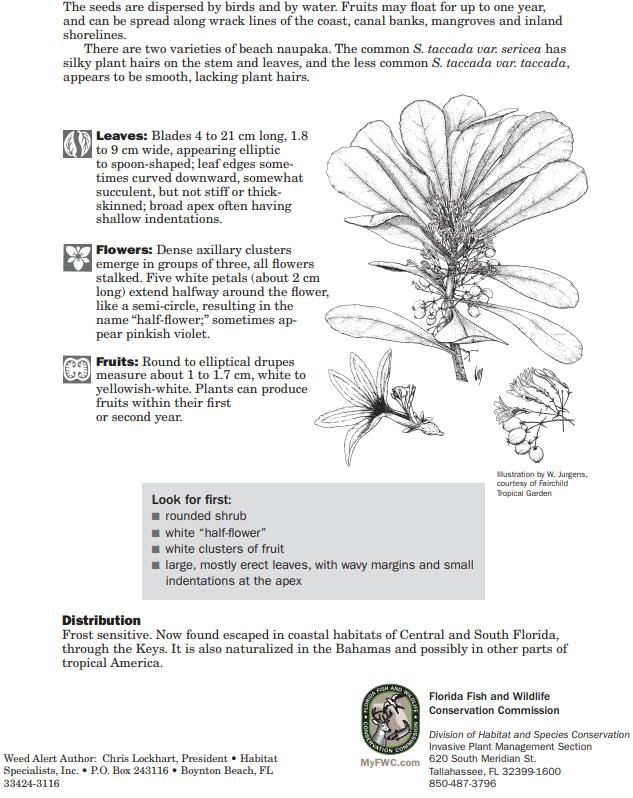
Beach Naupaka
Scaevola taccada
Why beach naupaka must be managed:
Shrubs of beach naupaka produce copious fruit clusters and can grow to heights of 5 meters (16 feet). They displace native dune vegetation, including sea oats, that helps to guard against erosion. This shrub consumes open spaces on the dune that are important for the endangered sea lavender (Argusia gnaphalodes), beach peanut (Okenia hypogaea), beach clustervine (Jacquemontia reclinata), and threatened inkberry. Because of its rapid growth and expansion, some municipalities have authorized the removal of beach naupaka within 10 years of planting.
Beach naupaka is difficult to control. The fleshy branches are easy to hand pull, but broken underground stem segments readily resprout if not completely removed. Herbicides have been effective in the dry dunes, but removal and treatment of beach naupaka in tidal mangrove areas requires more careful treatment. Monitoring and re-treatment are necessary for at least two to three years after removal, to weed out new seedlings and stem sprouts
Removal Techniques
- Hand pull seedlings (carefully, soft stems and roots break off and resprout)
- Cut back larger plants and spray stems at the base with herbicides
- Dispose of material with garbage
- Pull seedlings and re-treat larger plants for at least two years and prevent re-invasion
Herbicides
- Herbicides are not effective on foliage
- Cut plant stems near base and bag and dispose of cuttings
- Apply herbicide with hand sprayer or wand to cut stumps
- Garlon 3A 50% solution
- Or, apply to the basal bark with hand sprayer
- Garlon 4 10% solution
- Pathfinder II
- Work early in the morning or when wind is calm
- Always follow manufacturer’s label
