
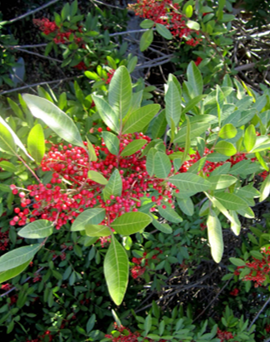
Brazilian peppertree
Schinus terebinthifolia
- Habit: evergreen shrub or small tree that can reach over 30 feet in height, typically with a short trunk hidden in a thicket of branches. Flowering occurs from September through November and fruits are usually mature by December.
- Leaves: alternately arranged with 1-2 inch long, elliptic, and finely toothed leaflets. Can be reddish, often possessing a reddish mid-rib.
- Flowers: flower clusters are white and 2-3 inches long with male and female flowers that look very similar.
- Fruit: glossy fruits are borne in clusters that are initially green, becoming bright red when ripe.
- Seeds: dark brown and 0.3 mm in diameter.
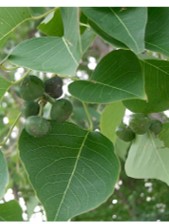
Chinese tallow
Triadica sebifera
- Habit: deciduous tree with a milky sap, grows up to 30 ft tall
- Leaves: simple, alternate, 1–2.5 inches wide, with broadly rounded bases and tapering to a slender point
- Flowers: Small yellow flowers that are borne on spikes to 8 inches long occur in spring
- Fruit/Seeds: 0.5 inch wide, 3-lobed capsule that turns brown at maturity to reveal 3 dull white seeds
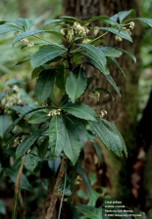
Coral ardisia
Ardisia crenata
- Habit: small upright shrub that can grow up to 6 feet in height. Grows in clumps, often times multi-stemmed.
- Leaves: dark green and thick, somewhat glossy, roughly 8 inches long with scalloped margins.
- Flowers: white or pinkish, borne in axillary clusters.
- Fruit: berries, which are readily eaten by birds, turn a bright coral red color and hang or droop on the plant
- Seeds: prolific seeds with >80% germination rate
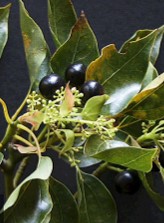
Camphor tree
Cinnamomum camphora
- Habit: large evergreen tree to 20 m (20-65 ft) with a stout, uniformly cylindrical bole and dense, symmetrical crown
- Leaves: alternate; blades entire but may have wavy margins, mostly ovate, 4-10 cm (1.5-4 in) long, glossy green above, duller green below
- Flowers: small, fragrant flowers are greenish white to pale yellow, borne on loose panicles about 3 inches long
- Fruit: small, dark blue to black, fleshy drupes approximately 1 to 1.5 cm in diameter.
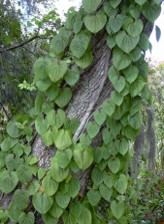
Air potato
Dioscorea bulbifera
- Habit: herbaceous twining vine, growing 70 feet or more in length
- Leaves: broadly cordate (heart shaped) and alternately arranged on stems; all leaf veins arise from the leaf base
- Flowers: inconspicuous, arising from leaf axils in panicles 4 inches long (fairly uncommon in Florida)
- Fruit: capsule
- Seeds: partially winged; vegetative reproduction is the primary mechanism of spread. This is through the formation of aerial tubers, or bulbils, which are formed in leaf axils. These vary in roundish shapes and sizes. In addition, large tubers are formed underground, some reaching over 6 inches in diameter.
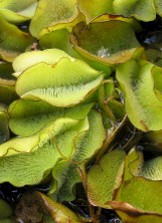
Giant salvinia
Salvinia molesta
- Habit: free-floating aquatic fern, dangling 3rd leaf resembles roots, hairy, about 10 cm long; great variation in form and structure depending on space and nutrient availability
- Leaves: oblong floating leaves, 1/2 to 1 1/2 inches long. Young plants have smaller leaves that lie flat on the water surface. As plants mature and aggregate into mats, leaves are folded and compressed into upright chains. Leaf surfaces have rows of cylindrical hairs topped with four branches that are joined at the tips to form a “cage”. These hairs give a velvety appearance and repel water.
- Spores: underwater root-like structures conceal stalks with egg-shaped spore cases.
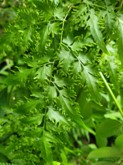
Japanese climbing fern
Lygodium japonicum
- Habit: perennial vine-type fern, reaching up to 90 feet in length
- Leaves: rachis is slender, winding and twining; sterile pinnae (major segments of the leaf blade) are opposite or alternate on the rachis, triangular in shape, bipinnately compound, superficially resembling miniature fronds of bracken fern; pinnules (divisions of the pinnae) are pinnate or pinnatifid, with a long and slender terminal lobe; fertile pinnae are on the same fronds as the sterile ones, but they are much lacier in appearance due to the slender, fingerlike lobes of the pinnules; bear sporangia (spore producing structures) in double rows under the margins
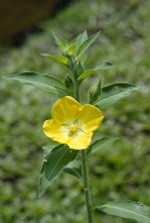
Peruvian primrose willow
Ludwigia peruviana
- Habit: shrubby perennial forb; semi-aquatic, reaching up to 15 feet in height
- Leaves: narrow and elliptic (lanceolate to ovate lanceolate), alternating leaves, rarely opposite, 5-15 cm long and 1-3 cm wide; both surfaces are pubescent
- Flowers: solitarily, perfect (both male and female); 4 sepals (8-12 mm long); 4, rarely 5, yellow rounded petals (1-3 cm long and wide)
- Fruit: short, stout, four-angled capsules, 1-3 cm long
- Seeds: buff to light brown, elliptical or oblong, and usually between 0.3 to 0.8 mm long
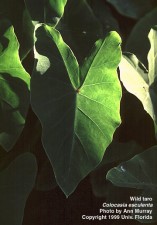
Wild taro
Colocasia esculenta
- Habit: perennial herb to 1.5 m (4 ft) tall, with thick shoots from a large corm; slender stolons also often produced, along with offshoot corms
- Leaves: peltate (stalked from back of blade); leaf blades to 60 cm (24 in) long and 50 cm (20 in) wide, arrowhead shaped, with upper surface dark green and velvety; petioles large, succulent, often purplish near top
- Flowers: Flowers tiny, densely crowded on upper part of fleshy stalk, with female flowers below and male flowers above. Flowering seldom occurs outside of the native range
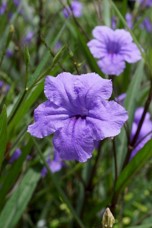
Mexican petunia
Ruellia simplex
- Habit: perennial herb, to 1 m tall. Stems green or purple.
- Leaves: dark green, opposite, lance-shaped, about 15-30 cm long and 1-2 cm wide, veins prominent below, margins smooth or wavy.
- Flowers: pedunculate, trumpet shaped, 4-8 cm in diameter, solitary or borne in clusters at the tips of the stems, usually purple, but white and pink forms exist.
- Seeds: cylindrical capsules containing 4-28 seeds. Capsules have explosive dehiscence with seeds spreading long distances.

Giant reed
Arundo donax
- Habit: large grass (to 20 ft. tall), with thick, hard rhizomes, stems are cane-like, tall, erect or leaning
- Leaves: leaf blades are numerous, stiff, to 3 ft. long, to 2 in. wide, smooth, rounded at base, tapering to a long point; sheaths smooth; ligules large, papery, small hairy margin
- Flowers: inflorescence a dense erect loose spike, to 2 ft. long, feathery, whitish to brown
- Fruit: spikelets stalked, solitary; flowers with long silky hairs (awns)
- Seeds: may not produce seeds outside of native range
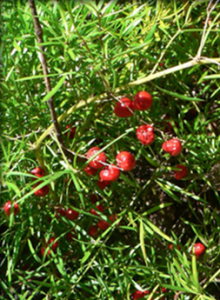
Asparagus fern
Asparagus aethiopicus
- Habit: slightly woody, evergreen herb with a sprawling habit. Tiny spines are borne in axils along branches.
- Leaves: needle-like, reduced to scales but leaf-like, solitary or with clusters of two or three linear branchlets called cladophylls
- Flowers: many, small, fragrant white or pale pink flowers in short axillary racemes 1-3 cm long
- Fruit: small, bright red, 1-3 seeded, globose berry 6-12 mm in diameter
- Seeds: black 3 mm diameter
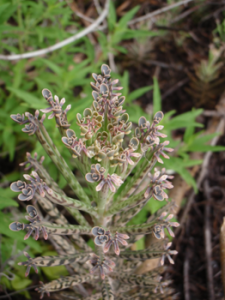
Kalanchoe
Kalanchoe x houghtonii
- Habit: Succulent herb. stems are hollow, fleshy, dark green.
- Leaves: Leaves are more fleshy, slender, long and come to a point.
- Flowers: bell-like and pendulous, green to red.